The Challenge: A 5–10°F Difference Between Floors
Older homes are part of what gives Chestnut Hill its character. Their layouts, construction styles, and architectural details make them special—but they can also create unique heating and cooling challenges.
This customer was experiencing one of the most common comfort problems in a multi-story Philadelphia home: the first and second floors rarely felt the same. Temperatures could vary by 5–10°F between floors. When one level felt comfortable, the other could be noticeably warmer or cooler. The problem was especially frustrating at night, when they wanted the second floor cool enough for sleeping. To make the upstairs comfortable, they often had to lower the thermostat much farther than preferred. That helped the bedrooms, but it also sent unnecessary cooling to the first floor and left the downstairs too cold.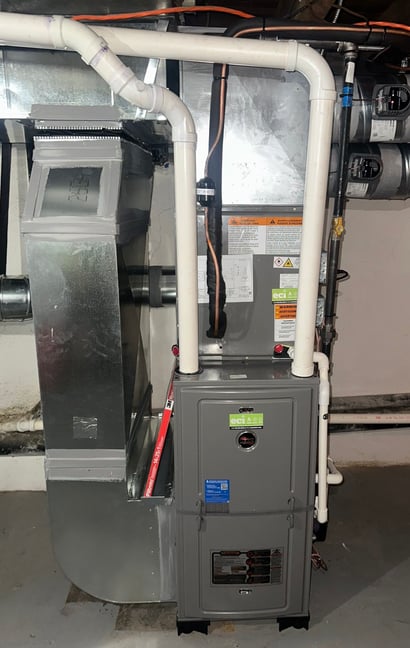
The issue was not simply that the existing HVAC equipment needed to be replaced. The issue was that a single thermostat was trying to manage two floors with very different comfort demands, while the existing duct system could not independently direct heating and cooling where it was needed.
Our customer also wanted to modernize the way their home was heated. Their existing furnace was approximately 80% efficient, and they were interested in a system that could reduce energy consumption and lower the home's carbon footprint without giving up dependable heat during a Philadelphia winter. The right solution needed to address comfort, airflow, efficiency, humidity, sound, and environmental impact together.
Designing a Zoned Hybrid HVAC System for an Older Philadelphia Home
The customer's goals called for more than a standard furnace and air-conditioner replacement. The home needed a system capable of responding to changing conditions on each floor.
The solution was a zoned hybrid heating and cooling system with new ductwork, built around:
-
A Ruud two-stage, variable-speed furnace rated at 96% efficiency
-
A Ruud RD18 fully modulating heat pump
-
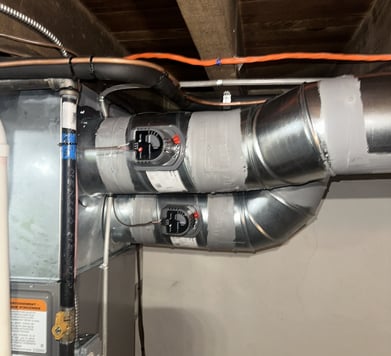
Separate heating and cooling zones for the first and second floors
-
New ductwork designed to support independent zoning
-
Individual temperature control for each level
This hybrid—or dual-fuel—design allows the electric heat pump to provide efficient heating when outdoor conditions are appropriate. When the home needs additional heating capacity, the high-efficiency gas furnace is available to take over. Rather than forcing one piece of equipment to handle every condition in exactly the same way, the new system can adapt to the weather, the home's demand, and the needs of each floor.
A 96% Efficient Two-Stage Ruud Furnace
The new 96% efficient Ruud furnace represents a significant improvement over the customer's previous 80% efficient furnace. An 80% efficient furnace converts roughly 80% of the fuel it uses into heat for the home, with the remaining energy lost through the exhaust. A 96% efficient furnace converts a much larger share into usable heat. Actual energy use and savings depend on factors such as weather, thermostat settings, system sizing, ductwork, utility rates, and how the home is used, but the equipment provides a much more efficient foundation.
The furnace's two-stage operation also helps it respond more closely to actual heating demand. During milder weather or when only a smaller amount of heat is required, the furnace can operate at its lower stage. When outdoor temperatures fall and the home needs more heating capacity, it can move to its higher stage. That flexibility is especially useful in a zoned home. If only one floor needs heat, the furnace does not necessarily need to operate at maximum output. Longer, lower-stage cycles can provide steadier warmth and help reduce the temperature swings often associated with single-stage equipment.
A Fully Modulating Ruud RD18 Heat Pump
Outside the home, the Ruud RD18 modulating heat pump gives the customer a more precise way to heat and cool. A traditional single-stage air conditioner works much like a standard light switch: it is either fully on or completely off. When the thermostat calls for cooling, the system starts at full capacity. When the target temperature is reached, it shuts down.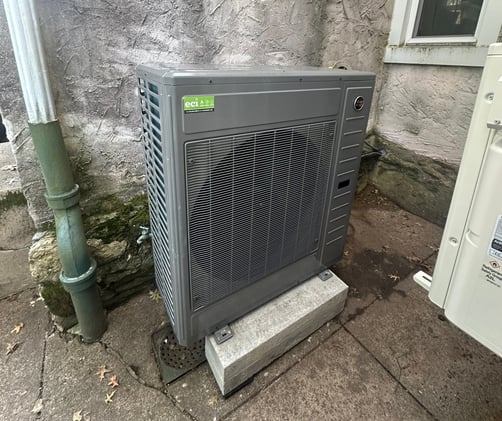
The RD18 behaves more like a dimmer switch. Instead of relying only on full output, it can adjust through a wide operating range—roughly 40% to 100% capacity—to better match the home's changing needs.
On a mild afternoon, the heat pump may only need to operate at a lower level. As the outdoor temperature rises or the cooling load increases, it can gradually increase its output. The same ability to adapt supports heat-pump operation during the heating season. This means the customer's home no longer has to rely on an oversized burst of heating or cooling for every call. The equipment can respond more precisely to the conditions at that moment.
New Ductwork Built to Support Two-Zone Comfort
Simply adding dampers to an existing duct system would not have addressed the underlying airflow problem. New ductwork was installed for the first and second floors so each zone could receive the appropriate amount of conditioned air. The duct design supports the furnace's variable-speed airflow, the heat pump's modulating capacity, and the independent calls from each thermostat.
This coordinated approach helps the system deliver comfort where it is needed instead of trying to solve every imbalance by lowering or raising a single thermostat. For older homes in Chestnut Hill, Mt. Airy, Germantown, and other established Philadelphia neighborhoods, thoughtful duct design can be just as important as the equipment itself. High-efficiency HVAC equipment performs best when the air-distribution system allows it to do its job.
Considering a Zoned or Hybrid HVAC System in Philadelphia?
Temperature differences between floors are common, but they are not always solved by installing a larger air conditioner or lowering the thermostat. Equipment sizing, duct design, airflow, zoning, humidity, and the home's construction all play a role.
For homeowners in Chestnut Hill and throughout the Philadelphia area, a zoned hybrid heating and cooling system can offer a practical path toward better comfort, higher efficiency, and more control over how energy is used. ECI Comfort can evaluate the home, explain the available options, and help identify a solution that fits the building and the people living in it.

ECI Comfort specializes in installing Ruud systems in and around Bucks, Montgomery, and Philadelphia area. If you are interested and would like to know more, click the button above or reach us at (215)245-2300 or info@ecicomfort.com